How could you do this when I so loved you?
Blank stares, as if all emotions were dead
I was lost, broken, trying to get through.
No quarrel, no warning, you just withdrew
my heart crushed inside from all that you said
How could you do this when I so loved you?
Alone with dark thoughts, compelling me to
bring an end to it all, find peace instead
I was lost, broken, trying to get through.
I did what I could, what more could I do
I stayed by your side, laid hands on your head
How could you do this when I so loved you?
Disconnected, detached from all I knew
Isolated, adrift, darkness and dread
I was lost, broken, trying to get through.
Dreams and plans destroyed, our lives split in two
the story of our love, marked up in red
How could you do this when I so loved you?
I was lost, broken, trying to get through.
Analysis
1. About this poem
“Dialogue 1 – Broken” is a poem in two voices, a man and a woman, at the moment their relationship comes apart. He has left without explanation. He didn’t leave out of anger or for someone else. He left in desperation. He is consumed by dark thoughts, including the pull toward ending his life, and leaving is a last attempt to escape them, a hope that a change might bring relief. She is left reeling, hurt and bewildered, asking the question that becomes her refrain: how could he do this when she loved him so much?
The poem is told from his point of view. Her words are not a record of what she said. They are what he imagines she is thinking: her grief, her sense of betrayal, her insistence that she did everything she could. Against that, his own voice is depleted and flat: lost, broken, detached, isolated, adrift.
At its heart, the poem is about love destroyed by overwhelm and despair, not by conflict or cruelty. There is no quarrel and no villain. There are two people who cared, in different ways, and an illness that leaves one of them unable to reach the other, or even to feel what he once felt. The tragedy lies in that gap.
2. The poem’s form
The poem is a villanelle, one of the most demanding fixed forms in English. A villanelle has nineteen lines: five three-line stanzas followed by a closing four-line stanza. It uses only two rhyme sounds throughout. Two lines from the first stanza return again and again as refrains, alternating at the end of each stanza, until they finally appear together as the closing pair. Here, every line is also exactly ten syllables.
The name comes from the Italian villanella, a rustic song of the sixteenth century, and early French villanelles were loose pastoral pieces. English poets took up the form in the late nineteenth century, often for light verse. In the twentieth century it became a vehicle for intense feeling. Dylan Thomas’s “Do not go gentle into that good night,” Elizabeth Bishop’s “One Art” and Sylvia Plath’s “Mad Girl’s Love Song” are among the best known.
The villanelle suits grief and obsession because of its circling repetition: thoughts return no matter how far the poem moves. This poem gives that repetition an unusual twist by assigning each refrain to a different speaker.
3. The layout and typography
The poem is laid out to resemble a conversation in a messaging app. The man’s lines sit on the left of the page and the woman’s on the right, like the two sides of a chat window. Centred lines in italics belong to a narrator and appear the way system notices or status updates appear between messages. The effect is immediately familiar: a reader knows who is “speaking” before reading a word.
The arrangement does several things. First, it splits the villanelle’s refrains between the two of them. Her question, “How could you do this when I so loved you?”, always hugs the right margin. His line, “I was lost, broken, trying to get through,” always returns to the left. The form’s insistent repetition becomes a pair of messages sent back and forth, each repeated without quite landing.
Second, the stanzas take turns. The opening stanza contains all three voices. After it, she has the second and fourth stanzas and he has the third and fifth, like turns in an exchange. Yet they never actually respond to one another. She recounts what she did and how she was hurt, and he describes what was happening inside him. The layout looks like dialogue, but the content shows two people talking past each other, each sealed in a column.
Third, the narrator occupies the space between them. The centre of the page belongs to neither, and the italic lines placed there carry the bleakest observations. At the start comes “Blank stares, as if all emotions were dead.” At the end comes “Dreams and plans destroyed, our lives split in two / the story of our love, marked up in red.” The first line describes him from outside, as she might see him. The last speaks of “our lives,” as though the narrator stands in for both of them, or for the man stepping back to see what has happened to them as a couple. A story “marked up in red” suggests something judged, corrected and found wanting.
In the final quatrain all three voices appear together. The two refrains sit one above the other on opposite sides of the page, which is the closest the two come to direct exchange. Even then, they remain apart.
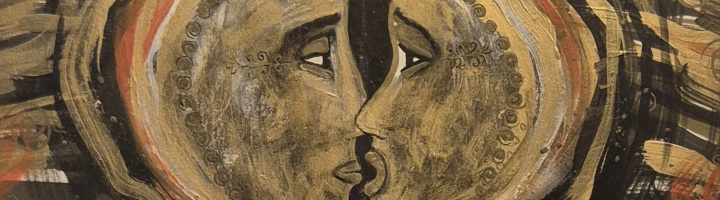
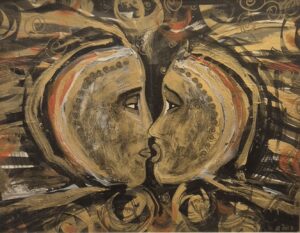
The painting at the top of the page completes the picture. It shows two faces in profile, his on the left and hers on the right, so the image and the text share the same geography. Their faces almost meet, but his is blank and flat in affect, while hers shows pain and sorrow. She leans toward him, trying to close the distance. He stays fixed in place, lost and broken, dissociated and detached from his own emotions. The narrow dark seam between their faces mirrors the empty centre of the page that only the narrator crosses.
Around him, the painting is full of swirls, restless shapes that crowd the frame. These are his thoughts, ever present and inescapable, including the intrusive suicidal thoughts the poem names in its third stanza. Read alongside the painting, the left-hand column becomes the view from inside that swirling space. The right-hand column becomes the woman he can see reaching for him but cannot feel.
4. Meter and mental states
The poem uses meter, the pattern of stressed and unstressed syllables, to separate the two minds. Every line has the same ten syllables, so the difference lies in how the stresses fall, not in line length.
Her lines move with an even beat, like someone walking at an unhurried pace. “How could you do this when I so loved you?” runs smoothly, with regularly spaced stresses and no awkward clusters. “I did what I could, what more could I do” rolls forward steadily, the weight falling on “did,” “could,” “more” and “do.” Her rhythm loosens a little when she recalls what she did and what was said. In “my heart crushed inside from all that you said,” the phrase “heart crushed” pushes two stresses together, and “laid hands on your head” carries a similar weight. Even so, she never loses her footing. Because she exists only in his imagination, that steadiness is how he pictures her: someone grounded enough to hold her ground when he cannot.
His lines stumble, stall and falter. Commas break up “I was lost, broken, trying to get through,” and “lost, broken” stacks stress against stress so the line catches on itself. “Isolated, adrift, darkness and dread” opens with a heavy, falling four-syllable word, pauses, then jams “adrift” against “darkness.” “Disconnected, detached from all I knew” spends its opening on one long word that halts at a comma before “detached” repeats the idea, as if he were searching for words. These lines read like someone struggling to put one foot in front of the other.
The most striking metrical moment is the enjambment in the third stanza. Enjambment is when a sentence runs past the end of a line without a pause, so the meaning spills into the next line:
Alone with dark thoughts, compelling me to
bring an end to it all, find peace instead
The first line ends on “to,” a word that cannot stand on its own. It satisfies the villanelle’s rhyme, chiming with “you,” “through” and “withdrew,” but it leaves the phrase hanging over the edge of the line. The reader is pulled across the break to learn what he is being compelled to do, just as he is pulled by the thoughts themselves. The stall at the line’s end, a brief suspension before the phrase completes, enacts the hesitation of someone standing at an edge. The resolution, “find peace instead,” is chilling precisely because “peace” sits where comfort ought to be.
Although the poem is structured as a dialogue, it is essentially an internal monologue. Every word attributed to her is what he imagines she is thinking, so her steadiness, her grief and her accusing refrain are all his creations. That makes the contrast in meter doubly revealing. He can imagine composure, but he cannot find it in himself. The even rhythm he gives her measures how far he feels from solid ground, and her repeated question may be as much his own self-reproach as anything she would say. The conversation is really one mind arguing with itself, split between the person he is in this state and the person he believes he has hurt.
5. What the author is trying to convey
Overall, the poem conveys how depression and suicidal ideation can sever a person from his own emotional life and, through that, from the people who love him. The man does not stop loving out of indifference. He becomes unable to feel, to show feeling or to reach out. From the outside, that looks exactly like coldness: blank stares, sudden withdrawal, no explanation. The poem suggests that what reads as abandonment may be a symptom of illness. It also suggests that the person withdrawing may be suffering as acutely as the person left behind, only without access to the feeling.
That is why the imagined voice matters. He can construct her pain in vivid detail, but his own lines stay largely abstract: lost, broken, detached, adrift. He relocates the emotion he cannot find in himself onto her, which is a quietly accurate picture of dissociation.
The final word carries much of the poem’s weight. “Trying to get through” can mean trying to survive, to get through the darkness to the other side. It can mean trying to get through to her, to communicate, which fits the chat-window design and its unanswered messages. It may even carry a darker echo of being “through,” as in finished. The past tense of “I was lost” adds another layer: he speaks from after the event, which suggests he did get through in one sense, even though the relationship did not. The poem never settles which meaning governs, and the ambiguity is earned, because each reading is supported by what comes before.