To live like children until we die
We will learn, love and laugh then poof, we’re dead
I’ll love you until then, ok, byebye
Kiss me quite insane, through a mad girl’s eye
Wild wanton wanting, no desire unsaid
To live like children until we die
Old age should burn, rage and defy
Play, love, dance to the end, deny death’s dread
I’ll love you until then, ok, byebye
If I could tell you love has no why
Ignore time’s tortured toll and tireless tread
To live like children until we die
Slowly the poison bled an old dog dry
So senseless, silly, live fully instead
I’ll love you until then, ok, byebye
Feel your fate, that of those so close by
Unthinking, unplanned, unlearned, born and led
To live like children until we die
I’ll love you until then, ok, byebye
With love to Plath, Thomas, Auden, Empson, Roethke
About this poem
I love you, ok, bye-bye is a villanelle – a 19 line poetic form with a strict rhyming and repetition structure. This poem was designed to be read two very different ways. On the surface it is a love poem about mortality and living life to the fullest (a topic of mortality is very common in villanelles). Upon closer inspection, readers familiar with the form might see that this poem alludes to 5 of the most famous villanelles in the English language, giving it a whole new meaning. Not only does it advocate for a childlike approach to life and love, it enters a conversation with 5 master poets through their most famous villanelles. See the analysis below for all the gory details.
Analysis
1. The Poem’s Form
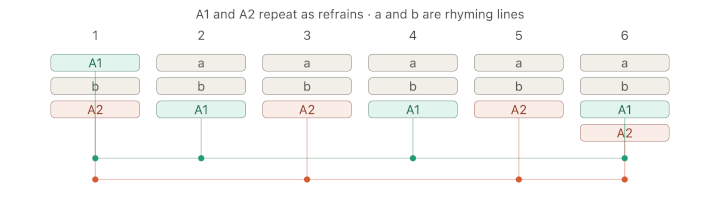
The villanelle runs nineteen lines: five tercets and a quatrain, rhyming ABA and then ABAA. Two rhyme sounds carry the whole poem, one landing seven times and the other six, with nowhere to hide a weak rhyme. Two refrains, fixed as lines one and three of the opening tercet, alternate at the end of each following tercet and then arrive together to close the quatrain — which puts eight of the nineteen lines beyond further control once the first stanza is set. The form’s real subject is what a repeated sentence comes to mean as the material around it changes.
The pictogram above the poem is a graphical depiction of the form of a standard villanelle.
To that inherited machinery the author adds five rules:
Every A line after the first tercet alludes to a famous villanelle.
Every B line is exactly ten syllables.
Every B line contains a three-word alliteration.
Every B line uses the style, mood or word choice of the referenced villanelle.
Every B line unifies the reference in the A line with the poem’s thematic centre.
These compound rather than add. One B line has to hit ten syllables exactly, land a three-word alliteration, sound like a specific dead poet, rhyme on a sound already used several times, and fold that poet into the poem’s own position — six times over, on a single rhyme. The A lines have their own version: each must be a recognisable quotation and still read as plain English. No poet and no title is named anywhere in the nineteen lines, so every reference is carried by the words themselves rather than announced.
That is where the central irony sits, and it’s not just decorative. The poem argues for freedom from restriction — play, love, the unplanned life — and delivers the argument through the least free thing available, tightened by rules nobody required and executed without visible strain. Anyone can recommend looseness loosely. The discipline is the evidence that the abandon being described is a chosen stance rather than an absence of rigour.
The first of those rules makes the poem allusive by design. The opening stanza sets out its own position plainly before any of the borrowing starts. Every A line after the opening stanza reaches outside itself and leans on a different well-known villanelle. Two of those positions are fixed. Plath is first because her flippancy is in the refrains, so the poem is already speaking in her register before her stanza arrives and after it leaves. Roethke is last because he is the only one who is not contradicted. The three between them could be reordered without issue, and are essentially three refusals, taken in turn. The three ways are the ways an adult gets the interval wrong — fighting it, falling silent before it, counting it — and the poem examines each one and pushes back.
2. The First Stanza — The Thematic Core
To live like children until we die
We will learn, love and laugh then poof, we’re dead
I’ll love you until then, ok, byebye
This is the only stanza that borrows nothing. It speaks in the poem’s own voice, unmediated by anyone else’s, and everything the following five stanzas do is measured against the ground it lays down.
A1 states the programme: “To live like children until we die.” Both halves carry weight. The manner is childhood, and the term is mortality, and the word joining them is “until” rather than “before” or “despite.” That makes the childishness conditional on death instead of opposed to it. The proposal is not to forget that the end is coming but to behave a particular way in full knowledge of it.
A2 states the address: “I’ll love you until then, ok, byebye.” The same deadline returns, now attached to love and to a second person who has not been introduced and does not need to be. Between them the two refrains contain the entire poem — a way to live and somebody to live it with, both bounded by the same clock. And the sign-off does its own work: “ok, byebye” is what a child says leaving a room, and, as an homage to Plath, the flippant and the mortal placed side by side with no attempt to rank them.
The B line sets the template the rest of the poem follows. “We will learn, love and laugh” is a three-word alliteration on l, three verbs in a row, playful in exactly the nursery-rhyme way that alliteration itself is a child’s pleasure — so the device announces the argument before any of the argument has been made. Then the line breaks in half: a whole life in the first six syllables, its end in the last four, hinged on “poof,” a nursery word doing the work of dying. Every later B line inherits both templates, the sonic one and the tonal one.
3. The Remaining Stanzas
Stanza 2 — Mad Girl’s Love Song, Sylvia Plath
Kiss me quite insane, through a mad girl’s eye
Wild wanton wanting, no desire unsaid
To live like children until we die
Plath’s poem is solipsistic in the strict sense. World and lover exist only while she attends to them, and the parenthetical refrain keeps conceding she may have invented him.
The A line lifts “kissed me quite insane” from “And sung me moon-struck, kissed me quite insane,” while “a mad girl’s eye” glances at the title. The lower case reads as ordinary description and only lights up for a reader who already knows the poem. The echo is more than verbal anyway: her phrase sits in a stanza of hallucinatory extravagance, and the line holds that pitch. Nobody speaks this way except at full volume.
What the speaker does with her is convert past tense into imperative and solitude into company. Her madness was the proof that nothing was there; “kiss me” needs a second person who can comply. The licence to be extravagant is kept and the isolation discarded.
The B line imports her appetite through the w-alliteration of “Wild wanton wanting,” then reverses her isolation with “no desire unsaid.” Her wanting stayed inside her head, unspoken and unverifiable. Here nothing goes unsaid, which is the thematic centre exactly: children want out loud, with no gap between the feeling and the announcement.
The refrain, arriving straight after an erotic demand, cannot mean innocence. Children means mode — unhedged, unembarrassed, saying the thing. It also bounds the Plath material: her madness had no edges because nothing in her poem was reliably real, while this one ends at a fixed point.
Stanza 3 — Do not go gentle into that good night, Dylan Thomas
Old age should burn, rage and defy
Play, love, dance to the end, deny death’s dread
I’ll love you until then, ok, byebye
Thomas’s villanelle is the loudest refusal in the tradition, spoken to a dying father, with love arriving as rage because rage is the only register the poem permits.
The A line compresses Thomas’s entire opening tercet into seven words. “Old age should burn” quotes his middle line verbatim; “rage” is the word his second refrain repeats; and “defy” puts into one verb what his first refrain, “Do not go gentle into that good night,” spends a full line refusing to say outright. Because a villanelle’s opening tercet holds both refrains and the line between them, that is not a sample of Thomas but the seed of his whole poem folded into a single line. The three modes are mixed on purpose — direct quotation, borrowed keyword, thematic paraphrase. His manner arrives with all of it: imperatives, short hard verbs, three stressed actions in a row, nothing softened.
What the speaker is saying against him is that the defiance can keep its shape and change its object. Thomas’s version requires an enemy and costs him enormously to sustain. This stanza aims the same burning and raging at play, removing the enemy without losing the energy.
The B line borrows from him twice. It alliterates on the d Thomas built his own poem from — dying, dark, good night — so the ear registers him at once, and “dance” is his word too, from the good men crying how bright their frail deeds might have danced in a green bay. In Thomas the dancing is hypothetical and already lost; here it is an instruction for the time remaining. The three verbs also answer the opening stanza directly, since “Play, love, dance” is built on the pattern of “learn, love and laugh” — the poem’s own first B line as template, this one as variation.
The refrain is almost impudent against father-son fury. Thomas would not tolerate “ok, byebye” within a mile of a deathbed. His defiance survives the translation; his anguish does not.
Stanza 4 — If I Could Tell You, W. H. Auden
If I could tell you love has no why
Ignore time’s tortured toll and tireless tread
To live like children until we die
Auden’s poem is about knowledge that never arrives: an indifferent authority with one unhelpful remark, and a refrain promising disclosure in a form that guarantees none.
The A line takes his conditional and completes it, supplying the content he never delivers. The subjunctive and the flat understatement are his, so the line sounds like Auden while doing the one thing Auden would not do.
What the speaker is saying against him is that the withheld answer, once produced, turns out to be an absence — and that this is a relief rather than a loss. His silence implies the explanation would console if it could be spoken. The stanza’s position is that love without a reason cannot be argued away, since there is no premise underneath for anyone to attack.
The B line runs on Auden’s own figure for time and on the letter t, which it presses further than the rule requires: “time’s tortured toll and tireless tread” alliterates five words deep rather than three. The extra “T”s are doing the work of a clock. Five hard consonants falling at even intervals is tick tock tick tock, so the line does not describe time passing, it sounds it out, and the reader hears the mechanism before parsing what it means. The line is still built on the alliteration device a child would enjoy, while also being a sonic play of the sound of a clock.
What is offered against all that is not stopping the count, which is impossible, but simply not listening to it. Fighting time would be Thomas’s answer, given and declined one stanza earlier, and the poem does not repeat it. Ignoring is the child’s answer: no sense of a balance accruing, because no attention is paid to the ledger at all. The line is a flat imperative, and it sits directly beneath a conditional Auden could never finish — he cannot tell, so the poem simply tells.
The refrain then answers his suspended sentence. The reason cannot be told because there is not one, so the sane response is to live as though the question never came up. Auden’s adults are stuck knowing they cannot explain themselves; the refrain proposes people who never needed to.
Stanza 5 — Missing Dates, William Empson
Slowly the poison bled an old dog dry
So senseless, silly, live fully instead
I’ll love you until then, ok, byebye
Empson’s villanelle offers nothing: a life filling with what was never used, no exit, no beloved, no remedy.
The A line welds two moments of his together. “Slowly the poison” opens his refrain verbatim; “bled an old dog dry” comes from the transfusion stanza in which young dog blood buys a month’s desires. Two lines from different parts of the poem are fused into one ten-syllable sentence that reads as though it had always been one. The manner is his — flat, clinical, reporting an atrocity without adjusting tone. It is the only line in the poem that leaves the speaker’s own idiom entirely.
What the speaker says against Empson is nothing, and that is the move. The dog is his proof that a life cannot be topped up, and quoting the proof concedes the case. The disagreement is postponed by one line.
The B line then imports a different poet. “So senseless, silly” is a Plath-style flippancy set against laboratory gravity, and “instead” pivots: instead of the transfusion, instead of the arithmetic. Empson’s entire case is that what kills is the life not used, so “live fully” is a direct rebuttal, and it lands hard against the line above it — one life emptied out by procedure, the other spent by being used up properly. The month is not disputed. How to spend it is.
The refrain supplies the second person Empson never had. After an animal bled dry on a bench, a human address is the argument in miniature. The dog got a month; the speaker takes the month and says something to somebody.
Stanza 6 — The Waking, Theodore Roethke
Feel your fate, that of those so close by
Unthinking, unplanned, unlearned, born and led
To live like children until we die
I’ll love you until then, ok, byebye
Roethke stops fighting. He wakes to sleep and takes his waking slow, learns by going, and feels his fate in what he cannot fear.
The A line does what stanza five did, welding two moments of its source into one sentence. “Feel your fate” comes from “I feel my fate in what I cannot fear,” and “that of those so close by” compresses “Of those so close beside me, which are you?” Both of Roethke’s registers arrive with them: the sensory verb — feel, not think or know — and the turn toward the people standing nearby. It says their fate is the same fate. Roethke asks which of the people beside him the addressee is, trying to pick one out of the group; the poem answers that the question never needed settling, because what is being felt is held in common.
What the speaker does with him beyond that is convert twice. First person becomes second, so a report turns into an instruction, and the fate stops belonging to one man. Roethke’s acceptance is solitary and philosophical, a man alone with his own ending. This asks the harder version, since being unafraid of one’s own death is one thing and feeling the mortality of the people in the room is another.
The B line alliterates on a prefix rather than a consonant, three negations stacked into an anaphora, with “unlearned” inverting learning by going and “born and led” closing on being carried rather than driving. Those three un- words – “Unthinking, unplanned, unlearned” – are a definition of a child, so the line reaches the refrain’s vocabulary a beat before the refrain does.
Both refrains then close together. “To live like children until we die” has just been literalised by the line above it, and the last line narrows a stanza that had opened outward to those close by back down to one speaker and one person.
4. Conclusion and Commentary
What the speaker conveys is that dying is settled and fear of it is not. It happens, poof, and no amount of gravity postpones it. The poem visits five poets not to decide whether to die but to work out how to spend the interval, and it declines each of their postures in turn: not Plath’s isolation, not Thomas’s rage, not Auden’s silence, not Empson’s clinical despair. Only Roethke is kept, and even he is converted from report into instruction and widened from one man to a room. After all that technical labour the conclusion is almost embarrassingly plain — play, want out loud, don’t flinch — and the plainness is earned rather than naive, because every sophisticated alternative has been tried on and returned.
It is a love poem, and not incidentally. The formal evidence is in which refrain gets the last word, addressed to a second person present throughout, and in the fact that every borrowed poet is pulled toward that address. Plath’s solitary hallucination becomes “kiss me,” which needs someone to obey it. Thomas’s fury at a dying father is answered by a lover’s promise. Auden’s unspeakable feeling is named as love. Empson, who wrote a death poem with nobody in it, has a beloved inserted into the very line that concedes his argument. Five poems about mortality are systematically converted into one poem about a person, and that conversion is the argument. Death is the occasion; love is the subject.
On death, the view is that the avoidable part is the dread. Rage, arithmetic and the unanswered question all make the time before death worse without making death later. On love, the claim is stranger and better: love here defends nothing, delays nothing, and has no reason behind it. It is offered anyway, as the content of the interval rather than a shield against its ending, which is why the promise is always bounded. “Until then,” never forever. A love claiming no limit would be lying about the ending, and the poem does not lie about the ending anywhere.
As for whether the premise works: the risk in an allusive villanelle is that it becomes a puzzle box, erudition standing where feeling should be. This one escapes for two reasons. The refrains are unliterary — “ok, byebye” is the counterweight to the whole apparatus and does emotional work quotation cannot — and no poet or title is named anywhere, so the references have to earn their place as English rather than as citations. The constraints are also better chosen than they first look. Alliteration is a child’s pleasure, nursery-rhyme sound play, so requiring it in every B line reinforces the thesis instead of decorating it, and the same holds for the anaphora closing stanza six. The rhyme families were picked shrewdly too: the -y and -ed sounds are generous enough in English to absorb seven and six landings without visible forcing.
The strongest line is “Slowly the poison bled an old dog dry,” which fuses two Empson quotations into one image and gets a laboratory onto the page in a love poem without breaking anything. Its risk is real — for one line the speaker’s voice disappears entirely into somebody else’s — but it lands, because that is the stanza where the speaker has decided to concede rather than argue, and a borrowed voice is the right vehicle for a concession.
Three of the five A lines are welds of this kind, and they are the technical signature of the whole thing: separate lines from one source fused into a single sentence that reads as though it had always been one. The Thomas goes deepest, taking all three lines of his opening tercet, which in a villanelle means both refrains and the line between them. The Empson and the Roethke take two apiece. All of them stand on their own grammar. The last stanza’s “that of those so close by” needs nothing supplied and nothing forgiven, so no line in the poem has to be taken on trust while the reader works out where it came from.
What the poem does still ask for is knowledge. A reader who does not know the five villanelles gets a working poem, because every A line is a plain sentence, but loses the argument entirely, since the argument exists only in the conversions. That is the price of the premise, and the poem pays it knowingly.
Poof.