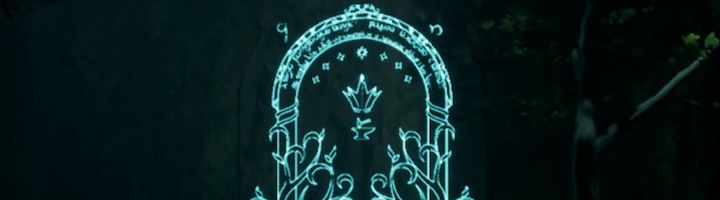
the invisible door
the cruelest of all barriers
gives hope of an opening
no indication where, no instructions how
worst of all
it lets you see the other side
maybe Gandalf will give me the word for friend
in old elvish
in new elvish
or does the dark tongue show the handle?
what if
on the other side
someone can see it
understand the mechanism
unlock its secret
is it locked, or is this all an illusion
only to find out there is no door
not even a barricade
all in my mind
the barrier
the blocking
the feeling that I’m being locked out
it’s coming from within, not without
how can I tell
introspection can only show what the mind can see
it cannot see what it doesn’t understand
The invisible door is a freewrite that was then polished slightly.
Analysis
The central image: a door that isn’t really a door
The poem opens by naming its subject directly — an “invisible door,” which it calls “the cruelest of all barriers.” That’s a deliberately strange way to describe an obstacle. A wall is bad, but at least you know where it is. This door is worse precisely because it isn’t a solid no — it “gives hope of an opening,” it shows you “the other side,” but it gives you nothing to act on: no location, no instructions, no handle you can find. The cruelty isn’t being blocked, it’s being shown what you’re missing while being given no way to reach it.
The poem’s core idea, stated up front: hope without a path is more painful than a flat refusal would be.
The Gandalf moment
The speaker then imagines Gandalf showing up with “the word for friend” — a reference to a moment in The Lord of the Rings where Gandalf is stuck at a magic door and tries every spell and password he can think of, in every language he knows, before realizing the door was never locked by a password at all — you just had to say the word “friend” out loud and push.
The speaker reaching for that story is telling. It’s a fantasy of rescue by knowledge — if only someone with the right words, the right language, the right key, came along, the door would open. It’s also, quietly, foreshadowing: in the actual Gandalf story, all that searching for the right magic phrase was beside the point, because the answer was never that complicated. The poem is setting up its own version of that same realization, a few stanzas before it gets there.
Someone on the other side
Next the speaker imagines a different kind of relief: not being rescued, but being seen. What if someone on the other side of this door could look at it, understand how it works, and open it — even if the speaker can’t? There’s something quietly lonely in this stanza. It’s not “I want out,” it’s “I want someone else to be able to do what I can’t.” The hope shifts from self-rescue to being helped by someone with a clearer vantage point.
The turn: maybe there’s no door at all
This is the hinge of the whole poem: “is it locked, or is this all an illusion / only to find out there is no door / not even a barricade / all in my mind.”
Everything up to this point has treated the door as a real, external thing — something with a lock, a mechanism, a possible key. Here the speaker suddenly questions that whole premise. What if there’s no door, no wall, nothing physically stopping them at all? The barrier might be entirely a construction of the speaker’s own mind.
This re-frames the entire poem retroactively. It’s no longer about a literal obstacle — it’s about anxiety, depression, self-doubt, or some other internal state that feels exactly like being locked out of something, even when nothing external is actually stopping you. “The blocking” and “the feeling that I’m being locked out” are named explicitly as feelings, not facts. The line “it’s coming from within, not without” is the poem stating its thesis plainly: the obstacle is generated by the self, not imposed by the world.
The ending: why this is so hard to fix
The last three lines are the most important, and the saddest, in the poem:
“how can I tell / introspection can only show what the mind can see / it cannot see what it doesn’t understand.”
This is the real trap the poem leaves you with. If the barrier is internal, you’d think the solution is simple: just look inward, recognize it’s not real, and walk through. But the poem points out why that doesn’t work — introspection, the act of examining your own mind, can only reveal what you already have the capacity to recognize. If the thing blocking you is rooted in something you don’t yet understand about yourself, no amount of self-reflection will surface it, because you’re using the very faculty that’s limited to try to see past its own limitation.
It’s a closed loop: the tool you’d use to escape the trap is itself caught inside the trap. The poem doesn’t resolve this — it ends on the question, not an answer — which is fitting, since the whole piece is about not being able to get past something you can’t fully see or name.
In short
The poem moves through three stages: first imagining the door as a real external puzzle to be solved (with a key, a password, a rescuer); then questioning whether it’s external at all; and finally landing on the much harder problem that if the barrier lives inside you, your own mind may not have the tools to find or name it. It’s less a poem about being trapped, and more a poem about the specific helplessness of not knowing whether you’re trapped by something real or by yourself — and not having a reliable way to find out.