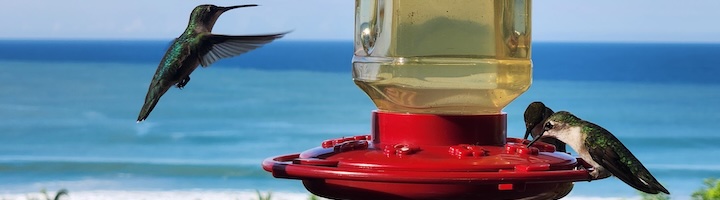
Colibris
the tiny descendant
of dinosaurs
now living in a world of giants
fragile, delicate,
afraid of a butterfly
yet still fast and daring
Once the god of war
and returning martyrs
now a symbol of
luck
beauty
joy
love
… love
if only we could all have that character arc
to wake up in war, conflict, brutality
and morph into love
the ultimate rejection of evil
the ultimate redemption
the ultimate salvation
is love
Analysis
Colibris is a freewrite about a creature born from war and violence — biologically (dinosaur descendant) and mythologically (Aztec war god, reborn martyrs) — that has been transformed into a symbol of love and beauty.The poem uses that transformation as a metaphor for the deepest kind of redemption: not defeating evil, but evolving past it entirely. It’s really a meditation on whether brutality can be alchemized into love — and the hummingbird as proof that it can.
The biology: Hummingbirds are, in evolutionary terms, literally tiny dinosaurs — birds descend from theropod dinosaurs, the same lineage that produced T. rex. So “the tiny descendant of dinosaurs / now living in a world of giants” isn’t just a poetic flourish; it’s scientifically accurate. The poem leans into the irony of that lineage: a creature descended from some of the most fearsome predators in history is now small enough to be wary of a butterfly, yet still possesses startling speed and aggression (hummingbirds are notoriously territorial and will dive-bomb rivals many times their size).
The Aztec mythology: This is where the poem’s central image comes from. In Aztec belief, Huitzilopochtli — the god of war and the sun — was closely associated with the hummingbird (his name roughly translates to “hummingbird of the south” or “left-handed hummingbird”). Warriors who died in battle or sacrifice were believed to be reborn as hummingbirds, returning to accompany the sun. That’s the “returning martyrs” line — it’s a direct reference to fallen soldiers transfigured into something small, swift, and luminous.
The cultural arc: The poem’s real move is tracking how that war-god symbol has been re-skinned over centuries into something almost opposite — in much of contemporary folk symbolism, hummingbirds now represent luck, joy, beauty, and love. The poem uses that transformation as a metaphor for a broader, cross-cultural human aspiration: the idea that violence and conflict can be metabolized into love rather than simply ended or avenged. This follows a Catholic redemption narrative (suffering transformed into grace, the martyr transfigured rather than just mourned, evil overcome not by force but by love), but the poem suggests it’s bigger than one tradition: a god of war becoming a symbol of love is the same shape as any culture’s redemption story.
The closing lines make the thesis explicit: the hummingbird’s mythic journey — sun, killing fields, sacrifice — to becoming a hummingbird, then to being culturally reread as a love-symbol, is itself the poem’s argument that the most radical form of redemption isn’t winning the war, but becoming unrecognizable to it.