Twins
I’ve known the twins all my life
unnamed in childhood
and ever near
dancing around me
taunting
bullying
unwelcome and unexpected
made their presence felt
intimidatingly tall
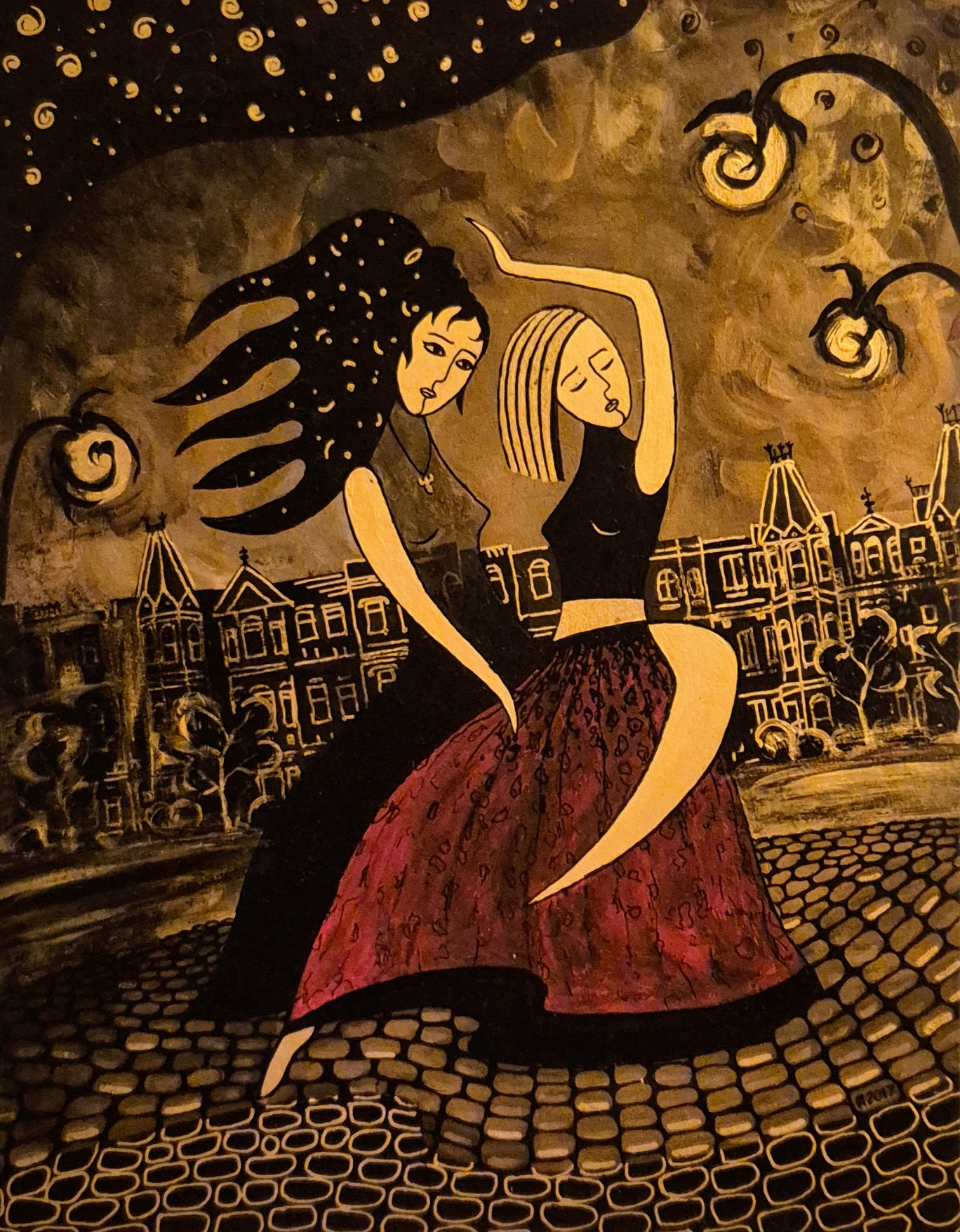
long dark locks
dragging night behind her
Dolores looms over everyone
moving slowly
she casts all in shadow
leaving memories of darkness
a fool’s hope for light
Angustina’s golden blond tresses
electrifying flashes bring unnerving surprises
she grips my chest
as I gasp for air
she releases only with fear
leaving nowhere safe
no place of refuge
my oldest companions
weaving the fabric of decades
they have shaped me
taught me humility
through grief
safety in introspective solitude
now named
their power wanes
if but just a little
a glimpse of normalcy
periods of relief
of joy
and love
quick to remind me
they remain
love.
Analysis of “Twins”
Identifying the Twins
The poem personifies two psychological states as twin figures who have accompanied the speaker throughout their life.
Dolores (from the Latin/Spanish dolor, meaning pain or sorrow) represents depression. Her characterisation is rich with symbolic weight: she is tall and slow-moving, with dark hair that literally drags night behind her. She casts shadow over everything, distorts memory toward darkness, and offers only a “fool’s hope” for light — capturing the cognitive distortion depression creates, where relief feels perpetually out of reach or illusory.
Angustina (from the Latin angustia, meaning anxiety, narrowness, or distress) represents anxiety. Where Dolores is slow and crushing, Angustina is electric and unpredictable — her golden hair suggests sudden flashes, her presence is a physical grip on the chest, breath withheld until fear itself becomes the release valve. This is a precise rendering of the anxiety response cycle: the body locked in threat mode, released only when it finds something to be afraid of, leaving no true safe ground.
Together they map onto the deeply common comorbid experience of depression and anxiety — states that frequently travel together, each feeding the other.
Their Presence Across a Lifetime
The poem traces three distinct phases of the speaker’s relationship with the twins.
Childhood and youth — they were unnamed, yet ever-present. The verbs here are telling: dancing, taunting, bullying. These are not passive visitors. They are active, even playful in their cruelty, arriving unwelcome and unexpected. The speaker had no framework for what was happening to them, only the felt experience of being haunted.
The long middle — the twins become oldest companions, a phrase that carries both intimacy and resignation. They have woven the fabric of decades, meaning they are not incidental to the speaker’s life but constitutive of it. Crucially, the speaker finds something unexpected here: humility through grief, and safety in introspective solitude. These are not defeats — they are hard-won adaptations. The inner world became a refuge precisely because the outer world, shaped by the twins, felt so unsafe.
The present, after naming — this is the poem’s quiet turn. The act of naming the twins diminishes their power, if but just a little. There are now periods of relief, of joy, and love — things that felt structurally impossible in earlier stanzas. Yet the final lines refuse a triumphant resolution: quick to remind me / they remain. The twins do not leave. The poem ends not with recovery but with a more honest, harder-won equilibrium.
The AuDHD Dimension
Knowing the speaker is a late-diagnosed AuDHD adult transforms the reading of almost every stanza.
The unnamed years carry a particular weight. For many autistic and ADHD individuals, decades pass without any framework for understanding why their nervous system responds so differently to the world. The twins being unnamed in childhood isn’t merely poetic — it reflects a lived reality of being told, implicitly or explicitly, that one’s suffering is inexplicable, exaggerated, or one’s own fault. Without diagnosis, there is no language, and without language, there is only the raw experience of being bullied by one’s own internal states.
Angustina’s anxiety has a specific AuDHD texture. The “electrifying flashes” and “unnerving surprises” speak directly to the experience of a nervous system that is simultaneously under-filtered and hypervigilant. For AuDHD individuals, the world does not arrive in managed doses — sensory input, social unpredictability, and executive demands all arrive at full voltage. The chest-grip and the struggle for breath are not metaphorical excess; they describe the literal somatic experience of a threat-response system that fires frequently and is slow to reset. Leaving nowhere safe / no place of refuge speaks to the exhausting impossibility of finding reliable regulation in a world calibrated for a different kind of mind.
Dolores’s depression is shaped by what is now understood as autistic burnout. The slow, all-shadowing quality of her presence, the distortion of memory toward darkness, the “fool’s hope for light” — these map closely onto burnout states that autistic people experience after sustained masking, overstimulation, or social performance. Unlike typical depressive episodes, autistic burnout can be prolonged and is often triggered by cumulative invisible labour. The speaker’s depression is not random; it has a structural cause that went unnamed for years.
The turn to introspective solitude as safety is distinctly neurodivergent. Where a neurotypical framework might read solitude as avoidance or symptom, for many autistic people it is genuinely restorative — a return to a self that does not have to translate itself for others. The poem honours this without pathologising it. Solitude is presented not as isolation but as the one environment the speaker could actually inhabit safely.
Late diagnosis reframes the naming as an act of liberation. The moment the twins receive names is not simply self-awareness — it is the retrospective reconstruction of an entire life. Late-diagnosed AuDHD adults often describe the diagnosis not as the beginning of understanding but as the key that unlocks everything that came before: every school difficulty, every friendship that collapsed, every job that ended, every period of exhaustion that looked like laziness. When the speaker says now named / their power wanes, there is something specific happening: the twins’ power wanes not because they have weakened, but because the speaker now has a coherent account of why they were always there. Shame, which feeds both Dolores and Angustina enormously, begins — just a little — to loosen.
The ending is neither cure nor defeat, which is the honest late-diagnosis position. AuDHD does not go away with diagnosis. Anxiety and depression, for many, remain structural companions of a nervous system that is genuinely different. But the final lines — quick to remind me / they remain — are not despairing. They are clear-eyed. The speaker knows the twins. They have names now. And knowing, even without curing, is its own kind of power.