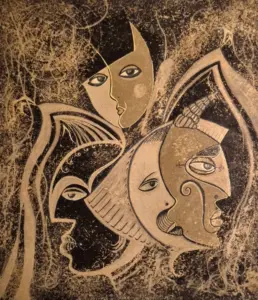
Masks
I was this many years old when
I was born
a castaway
cast out of the me’s that were,
but really weren’t.
today I learned
that the distance
and boundary
between me and the other
was unconsciously self made
to be quite honest
I didn’t expect
Prufrock’s time
to prepare a face to meet the faces
would be automatic, yet so taxing
my face when
I’m with the other
turns out not to be
my face after all
but a mask
if you know, you know
per sonare
the mask that resounds the voice
of a persona
is adapted for context
for what it’s worth
these masks
are created to protect
to appease
not to deceive
as far as I know
somewhere underneath
there is a self
me
unknown to me
that feeling when
I try to access it
my identity
the person that I am
is confusion and grief
too much information
they say
out of confusion
or frustration, disinterest
from the info dump
in real life
the world is made
for them
hence, sharing is unsafe
necessitating the mask
ask me anything
other than
how are you
or about the weather
small talk is excruciating
in my humble opinion
we could use more clarity
less reading
between the lines
of ambiguity
you should know
the intentional framing
adapting memes and scripts
while counting coffee spoons
is learned, real, and regulating
your mileage may vary
this process of discovery
after years
of misunderstood self
is difficult and ongoing
life pro tip
success and safety
isn’t a guarantee
hence the mask
is an important fallback
too long; didn’t read
who you see, who I am
are only the same, if you’re safe
it’s an automatic trait, learned long ago
gone unnoticed by me until now
Analysis of “Masks”
1. Structure
The poem consists of 14 stanzas, each of uniform length — exactly five lines. This rigid structural consistency is itself meaningful: the exterior form is controlled and predictable, while the interior content describes internal chaos and unknowing. The poem enacts what it describes.
Each stanza is headed by an internet or conversational meme header functioning as a title or framing device. No stanza uses traditional rhyme or meter; the lines are free verse with irregular syllable counts, conversational in register, and deliberately unadorned. Punctuation is minimal and inconsistent, mirroring the stream-of-consciousness quality and the difficulty of firm self-definition.
2. Stanza Headers: Scripts and Memes as Structure
Every stanza is introduced by a recognisable internet phrase or social script. This is not decorative — it is the central argument rendered as form. The speaker uses prefabricated social language to frame every single thing they say about themselves, including the revelation that they use prefabricated social language. This is formally recursive and deeply intentional. The meme headers are themselves masks: familiar, socially legible containers for content that is deeply personal and difficult to express directly.
These are predominantly internet community scripts — spaces historically more accessible to neurodivergent people, where communication rules are more explicit, tone is depersonalised, and there is less demand for real-time social performance.
3. Language: Intentional Choices
“cast away / cast out”
The opening stanza uses a deliberate pun on cast. “Castaway” evokes isolation and being marooned; “cast out” suggests expulsion. But cast also means to form something in a mould — and the poem is about the self being formed, masked, cast into shapes for others. The diagnosis is a birth into a truer identity while simultaneously a casting-out of all prior selves.
“per sonare”
The etymology of persona is given directly: Latin for “to sound through.” A mask, originally, was what an actor’s voice resounded through. This is precise and scholarly in the middle of a poem written in meme language — a register shift that illustrates the speaker’s mode of communication: the info dump, the sudden depth appearing unexpectedly. It reframes persona from “false self” to “functional instrument.”
“me’s that were / but really weren’t”
The plural of me is grammatically strange and intentionally so. There were many performed selves, none of them quite accurate. The grammatical violation enacts the conceptual one.
“confusion and grief”
These two words together are precise clinical-emotional language. Confusion is cognitive; grief is the emotional response to loss. Together they describe the experience of identity foreclosure — not knowing who you are, and mourning that not-knowing.
4. The Parallel with Prufrock
T. S. Eliot’s The Love Song of J. Alfred Prufrock (1915) is the controlling literary intertext. The speaker quotes it directly without attribution: “to prepare a face to meet the faces.”
In Eliot, Prufrock is a man of profound social anxiety and self-consciousness, unable to act or connect, perpetually performing a self he doubts. In Masks, the same preparation is revealed to be automatic and unconscious. This is the crucial difference: Prufrock knows he is performing; the speaker of Masks did not know until now. The poem reframes the performance from neurosis to neurotype — not chosen suffering but structural adaptation.
Both poems position the speaker as fundamentally separate from the social world. In Prufrock this is existential; in Masks it is neurological. The social world is not merely difficult but explicitly built for them, not the speaker.
5. The Double Meaning of the Spoons
As Prufrock Callback
Eliot’s line — “I have measured out my life with coffee spoons” — signals a life lived carefully, partially, in constrained portions. For the speaker of Masks it resonates as a description of how life is experienced: carefully rationed, measured, never full or overflowing.
As Spoon Theory
Spoon Theory, coined by Christine Miserandino in 2003, is a widely used metaphor in chronic illness and disability communities — including the AuDHD community — for limited daily energy resources. Every task costs spoons. Masking — the sustained performance of neurotypical behaviour — is understood to be one of the most spoon-expensive activities a neurodivergent person undertakes, often invisibly and automatically.
“Counting coffee spoons” therefore sits at the intersection of both meanings simultaneously: the Eliot allusion (a life measured in small portions, hemmed in) and spoon theory (the active, ongoing accounting of finite energy, with masking as a primary drain).
“the intentional framing / adapting memes and scripts / while counting coffee spoons / is learned, real, and regulating”
This is the speaker’s most explicitly self-aware moment: naming their own communicative strategies as conscious tools while acknowledging the energetic cost of deploying them. Learned, real, and regulating answers the implied accusation of fakeness: these strategies are not deception, they are adaptive coping.
6. What the Speaker Is Saying
At its core, the poem is an account of late AuDHD diagnosis narrated as a kind of second birth — and a second grief. The speaker has discovered, late in life, that their social self was not chosen but automatic: adaptations to a world not built for them. This discovery is simultaneously clarifying and destabilising. If the self that others know is a mask, and the mask was unconscious, then who is underneath it?
The speaker does not answer this. They state explicitly: “somewhere underneath / there is a self / me / unknown to me.” The self is posited but inaccessible. Trying to access it produces “confusion and grief.”
The poem moves through: the shock of diagnosis → retrospective recognition of masking → the etymology and function of persona → the purpose of masking (protection, appeasement — not deception) → social conditions that make masking necessary → specific sensory and communicative difficulties (small talk, ambiguity, info-dumping) → naming of strategies (memes, scripts, spoons) → the ongoing difficulty of this discovery → and finally a TL;DR thesis: the face you see and the self I am are only the same if I have assessed you as safe.
7. The Speaker’s Perspective Through the Lens of Late-Diagnosed AuDHD
The retrospective quality
Late diagnosis means looking back at a life and reinterpreting it entirely. The opening — “I was this many years old when / I was born” — is a birth that happens mid-life. All previous understanding of the self is retroactively revised.
Masking as the central experience
Masking is well-documented as a primary AuDHD adaptive strategy, particularly among those not diagnosed young — often because they masked so effectively. The poem’s central argument is that this masking was not conscious performance but structural, automatic, and invisible even to the speaker.
The inaccessible self
Identity disturbance is a recognised feature of both ADHD (rejection-sensitive dysphoria, unclear self-concept) and autism (difficulty with introspection, alexithymia). The speaker’s inability to access their own identity is not literary device but phenomenological description.
Specific social difficulties named
Small talk as “excruciating,” ambiguity as distressing, info-dumping as social liability, the world as built for neurotypicals — these are precise and recognised AuDHD experiences, named plainly.
Internet scripts as communication mode
Autistic and ADHD communities have found particular home in internet culture, where meme language provides a shared, structured, low-ambiguity mode of communication. Using these as the poem’s scaffolding is not ironic detachment — it is native language.
“Learned, real, and regulating”
This phrase answers the most common dismissal of late-diagnosed AuDHD adults: that their difficulties aren’t real, or that coping strategies mean they aren’t really struggling. The strategies are learned (not innate), real (not performance), and regulating (functionally necessary).
The safety-contingent self
The final stanza’s conditional — “who you see, who I am / are only the same, if you’re safe” — reflects the hypervigilance and trust difficulties common in AuDHD adults with trauma histories, for whom masking has been a genuine protection against misunderstanding, rejection, and harm. The mask is not vanity. It is armour.
Summary
Masks is a formally rigorous, self-referentially structured poem about the experience of discovering, late in life, that one’s social self has been an automatic, unconscious adaptive performance. Its use of internet meme headers as stanza frames enacts its subject — socially legible containers for genuinely difficult inner content. The Prufrock allusion reframes Eliot’s performed face from neurotic choice to neurological structure, while the coffee spoons hold both Eliot’s diminished life-measure and the disability community’s energy-accounting in a single image.
The poem does not resolve the self — it holds the inaccessibility of the self as its honest conclusion, and offers the mask not as deception but as a rational, protective, energetically costly, and ongoing response to a world built for someone else.
So thoughtfully written. So true.